
WHO seeks evidence for traditional medicine
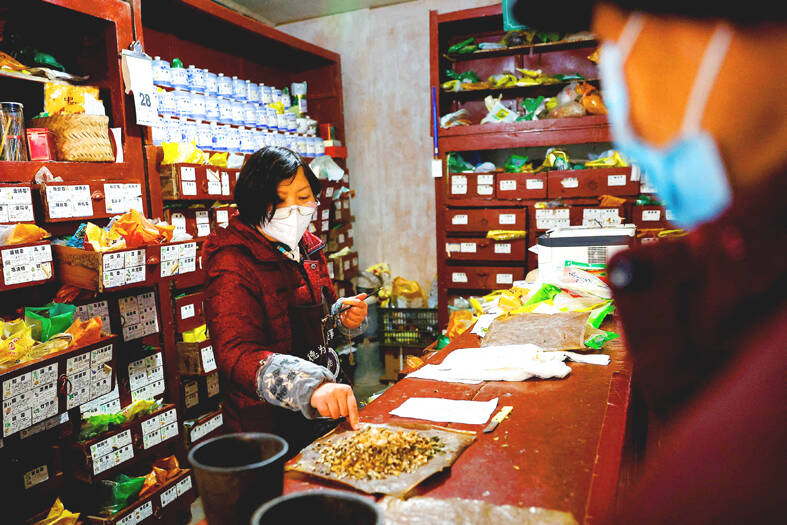
The WHO yesterday opened a major conference on traditional medicine, arguing that new technologies, including artificial intelligence (AI), can bring scientific scrutiny to centuries-old healing practices.
The summit in New Delhi, which runs until tomorrow, is to examine how governments can regulate traditional medicine while using emerging scientific tools to validate safe and effective treatments.
“Traditional medicine is not a thing of the past,” WHO Director-General Tedros Adhanom Ghebreyesus said in a video released ahead of the three-day conference. “There is a growing demand for traditional medicine across countries, communities, and cultures.”
Photo: Reuters
Indian Prime Minister Narendra Modi, a longtime advocate of yoga and traditional health practices, has backed the WHO Global Tradition Medicine Centre, launched in 2022 in his home state of Gujarat.
Center Acting Director Shyama Kuruvilla said that 40 to 90 percent of populations in 90 percent of WHO member states use them.
“With half the world’s population lacking access to essential health services, traditional medicine is often the closest — or only care — available for many people,” she said in New Delhi.
The UN agency defines traditional medicines as the accumulated knowledge, skills and practices used over time to maintain health and prevent, diagnose and treat physical and mental illness.
However, many lack proven scientific value, while conservationists warn that demand for certain products drives trafficking in endangered wildlife, including tigers, rhinos and pangolins.
The “WHO’s role, therefore, is to help countries ensure that, as with any other medicine, traditional medicine is safe, evidence-informed and equitably integrated in systems,” Kuruvilla added.
She said that “40 percent or more of biomedical Western medicine, pharmaceuticals, derive from natural products.”
She cited aspirin drawing on formulations using willow tree bark, contraceptive pills developed from yam plant roots and child cancer treatments based on Madagascar’s rosy periwinkle flower.
The WHO also lists the development of the anti-malaria treatment artemisinin as drawing on ancient Chinese medicine texts.
“It’s a huge, huge opportunity — and industry has realized this,” Kuruvilla said.
Rapid technological advancements, including AI, had pushed research to a “transformative moment,” to apply scientific rigor to traditional remedies.
The WHO is also to launch what it calls the world’s largest digital repository of research on the subject — a library of 1.6 million scientific records intended to strengthen evidence and improve knowledge-sharing.
WHO Chief Scientist Sylvie Briand said that AI can assist in analyzing drug interactions.
“Artificial intelligence, for instance, can screen millions of compounds, helping us understand the complex structure of herbal products and extract relevant constituents to maximize benefit and minimize adverse effects,” she told reporters ahead of the conference.
Briand said advanced imaging technologies, including brain scans, were shedding light on how practices such as meditation and acupuncture affect the body.
Kuruvilla said she was excited by the possibilities.
“It is the frontier science that’s allowing us to make this bridge … connecting the past and the future,” she said.
link