
A chemical analysis of 20th century traditional medicines curated at the Ditsong museum of culture History, Pretoria, South Africa
Results in context
The seven medicine containers analysed here comprise five horns from various species, a gourd and a leather pouch. They were collected from various parts of South Africa, Namibia and Zambia between 1912 and 1989. The contents of the two items collected from Namibia by Mönnig, namely the leather pouch (ET 1989/16) and one of the duiker horns (ET 1988/126) are referred to in the accession register by the name of n/om. Among the Ju/’hoansi, n/um refers to a supernatural potency that is activated through trance dances and the consumption of hallucinogenic drugs during healing rituals27. The different orthographies likely refer to the same thing and we can assume that the contents of these containers were intended to be used to get the user into a trance state. Containers ET 1983/132 and ET 61/21 are the only two that are purported to contain animal fat and the only two recorded as lightning medicine. While several compounds that derive from animal fats and oils were found in these containers, most are also found in small quantities in plants. Margaric acid, only found in trace amounts in plants but prevalent in the milk and adipose tissue of ruminants, was present only in ET 1983/132.
Six of the containers contain natural compounds with no medicinal properties but which are used frequently in the cosmetic or detergent industry. Specifically, ET 8582 and ET 1983/132 both contain high numbers of these industrial compounds. These ingredients have no known medicinal properties, and while it is plausible that they derive incidentally, they probably suggest preparatory contamination.
1-Naphthol, as a constituent component of the insecticide naphthalene could theoretically have been introduced during curatorial storage. However, given that all the containers were sealed with corks or paper stoppers and insecticide would not have been sprayed directly onto the artefacts, we consider curatorial contamination unlikely. It is also possible, that the containers themselves may have previously held some other substance. Here again, however, the horn container from which the 1-naphthol was identified is clearly a bespoke medicine holder, and even if it once held a different substance than what is currently contained, it is likely that this would still have been intended for medicinal usage. As mentioned earlier, 1-naphthol is found naturally in one North American and two central Asian plants. Given the date of 1983, it is plausible that one of these plants (probably Selaginella sinensis since it is the only one recorded in the context of traditional medicine) could have been added as an ingredient. However, given that 1-naphthol is most commonly produced synthetically, and given the association with other organic compounds with a primary industrial application, we feel that a pragmatic interpretation of the presence of this compound is from preparatory contamination. Although household detergents have been recorded as an intentional ingredient in lightning medicines28, the presence of these compounds in containers purported to contain actual medicine, would suggest an incidental rather than a purposeful origin. Although the final container may be a horn, leather pouch or gourd, this does not mean that the ‘medicine’ was originally prepared in these containers. It seems likely that other containers, perhaps acquired from discarded industrial or commercial refuse, were used to mix the medicines and that these compounds thus represent preparatory contamination. Given what we know about the conditions under which traditional medicines were prepared at the time, this hypothesis seems plausible.
Several containers also contained known toxins, only one of which, conhydrine, could prove potentially fatal if ingested in sufficient quantity. Conhydrine occurs naturally in two southern African aloe species, namely A. gariepensis (Pillans) and A. globuligemma29,30. This compound was detected in ET 1989/16 and ET 1983/132, the former of which comes from Namibia and is associated with n/um, and the latter of which comes from the Limpopo Province and is a lightning medicine. Even ET 1983/128, which was made for private use to treat epileptic seizures, contains at least three toxic ingredients. Unfortunately, we have no way of knowing how any of these medicines were intended to be administered and in what quantities, except that ET 1983/132 was probably never intended for human contact. Even highly toxic plants like Conium maculatum, the plant from which conhydrine was originally identified, are used medicinally in many homeopathic treatments31.
From a medicinal perspective, most of the 26 identified compounds with known medicinal properties are associated in the literature with such a wide range of medical applications and treatments (everything from controlling blood pressure to anti-cancer applications) that narrowing down the potential medicinal value of the recipes in each container is an impossible task. So too is any attempt to narrow down specific plant taxon ingredients, as most of the compounds identified are generic and widely distributed.
As is apparent from the accession information for each container, the medicines therein were not always intended to treat physiological ailments. Medicine is intimately articulated with culture, with some ingredients possibly added for their perceived apotropaic properties30,32, and administered to treat supernatural afflictions5,6. In the following section we explore the intersection of medicine and culture in some more detail.
The place of traditional medicine in African society
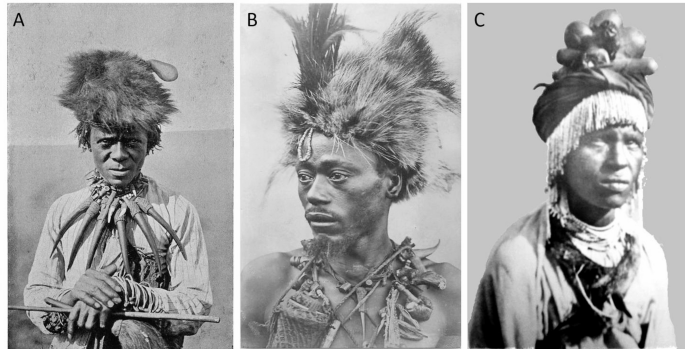
Traditional healers perform many roles in societies. They are the custodians of traditional religions and customs, educators, councillors and holistic healthcare practitioners who continue to provide a popular complementary service to mainstream allopathic clinical medicine9,33,34. Traditional herbal remedies are prescribed to treat all manner of ailments from simple infections, colds and flus to reproductive disorders, nervous complaints, tuberculosis and even malaria, diabetes and cancers18,19,35,36,37,38,39,40. The sheer number of plants that is used in these treatments is striking. In some cases, a single plant species may be administered to treat many very different ailments including supernatural afflictions6,16,33,41,42. Indeed, traditional medicine is prescribed not just to treat medical conditions, but also to impart supernatural abilities such as invisibility and imperviousness to bullets. The 1819 Battle of Grahamstown and the 2012 Marikana Massacre spring to mind in this connection.
A belief in witchcraft is endemic within this worldview43. A sudden illness or a run of bad luck could be attributable to witchcraft – a product of a malevolent sangoma. The witch-smelling practice, prevalent in many Nguni-speaking societies, polemicised traditional medicine within colonial jurisprudence. When witchcraft was suspected, a witchfinder would be tasked with finding (or “smelling out”) the witch. Once a person was accused of witchcraft they could, without trial or evidence, have all their possessions confiscated by the chief or be exiled or even summarily executed28,44,45,46. These arbitrary accusations and subsequent murders of innocent people led in 1957 to the passing of the Witchcraft Suppression Act (Act 3 of 1957), which was a consolidation of previous colonial legislation dating back to 1895 and which is still in force today in a slightly modified form (Act 50 of 1970). Notwithstanding the colonial conflation of African Materia Medica and witchcraft47, the Act did not proscribe the practice of traditional medicine as is often erroneously, and somewhat impertinently, claimed5,6,43. Rather, its aim was to prevent the arbitrary accusation of witchcraft and associated violence. Nevertheless, the practice of traditional medicine and witchcraft accusations continues today, perhaps partly because of the belief that the potentiality for malevolence is inherited47. It has been estimated that between 1985 and 1995 approximately 312 people were murdered in South Africa owing to accusations of witchcraft48. Witchcraft-associated murders remain rife in the country49,50.
Witchcraft is often associated with lightning, especially in rural areas, where it has been blamed for several natural deaths48,50,51. Lightning is believed to occur both naturally and through the action of witches who send it to harm people. Numerous plant species are used to make muthi to protect against lightning, although occasionally other ingredients such as powdered animal bones, tyre rubber and household detergents are also added. Lightning muthi is traditionally stored in antelope horns and administered by sprinkling around the house or occasionally by rubbing the mixture into subdermal cuts2,17,28,39,48,52. Indeed, the two larger antelope horns in our study (ET 61/21 and ET 1983_132), the latter of which contains several harmful toxins, were accessioned as lightning medicine. The wood of certain plants, such as Polystachya pubescens and Olea europa is believed to be used by witches to direct the course of lightning, but these plants are also used to treat other ailments, which if found in a person’s possession could lead to a false accusation of witchcraft39,52. The reality of witchcraft and magic as a feature of traditional medicine is recognised by the Traditional Health Practitioners Act (Act 22 of 2007), which formally recognises the role of traditional healers in contemporary society and provides a regulatory framework in which to ensure safety and quality of traditional health services.
Traditional medicine in South Africa is currently more popular than allopathic medicine by a factor of more than five to one6,53. Indeed, the trade in traditional medicines has been estimated to be worth around R2.9 billion annually, with 133 000 registered practitioners and 27 million consumers9. Yet, despite the formal recognition of traditional medicine and its popularity, especially in rural areas where it provides a more affordable form of healthcare, there is still great resistance and antipathy towards it from mainstream medicine, owing to its suspect methods of diagnosis and the fact that most remedies are clinically untested6. For one thing, some of the plants that are used are also highly toxic (e.g. Euphorbia ingens), which may easily lead to poisoning given that dosages are largely guesstimated by practitioners19,36,54,55. Also, not all of the medicinal plants that have been scientifically tested show any pharmacological activity for the conditions they are supposed to treat19. In some of the medicines that are pharmacologically efficacious it has been found that the preparatory steps (in some cases burning and mixing with animal fats, or administration as a water-based infusion, which would not extract the active low polarity molecules) actually destroy any medicinal benefit that the medicine would have had36,38. Although novitiates are apprenticed for a period of time to learn their trade, it is believed that traditional healers obtain their knowledge of herbal medicines and their ability to diagnose ailments through communion with ancestral spirits, who are also believed to be ultimately responsible for all illnesses56,57. Given this religious overtone to traditional medicine, it is perhaps unsurprising that the knowledge of mixing and administering muthi is kept secret58, making it that much harder for scientists to verify its medicinal potential.
Notwithstanding the problems attendant above, most people apparently believe that traditional medicine works59. And not wholly without reason. Approximately 74% of new drugs on the market have their roots in traditional medicine60. Despite the fact that not all medicinal plants exhibit pharmacological efficacy, many of them actually do35,37,61,62. In instances where medicines comprise complex recipes of many different plant ingredients there is some anecdotal evidence to suggest that such combinations have a synergistic effect that enhances the activity of bioactive compounds, thus rendering the recipes more efficacious than single-plant source remedies2,20,63,64, although the efficacy of these complex mixtures remains untested9. There is consequently broad consensus for the need for further bioprospecting studies and toxicity screening, both in terms of the potential for new drug discoveries, but also to lend greater acceptability and safety to the practice of traditional medicine9,20,38,65,66.
Traditional medicine is highly dynamic and adaptive. Social acculturation plays an important role in a medical practitioner’s choice of plant ingredients and medicinal recipes6,20,33, as indeed it does in many other aspects of indigenous knowledge systems67. The effect on traditional medicine is that remedies to treat particular ailments are prone to change from time to time, meaning that the ethnopharmacological knowledge collected today might not be relevant to older contexts. For this reason, the insights gained from biomolecular studies of historic collections, such as our one, can provide valuable information about the complex evolution of traditional medicines.
link