Environmental hazards from pollution of antibiotics and resistance-driving chemicals in an urban river network from Malawi
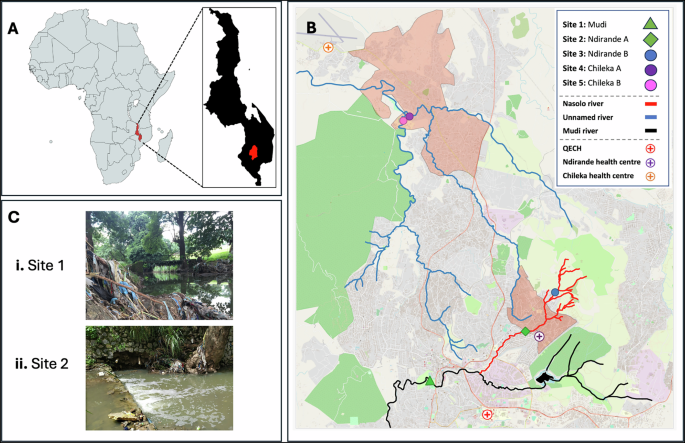
Five sites within an urban river system of Blantyre, Malawi were screened for acceptability to the populace and technical feasibility of sampling (Table S1) with 2 sites selected for longitudinal surveillance over an uninterrupted 12-month period between November 2020 to November 2021 (Fig. 1). Site 1 represented a river location downstream of the city centre/hospital and site 2 is a river location downstream of a dense urban community (Fig. 1b). Each river site underwent chemical sampling via Polar Organic Chemical Integrative Samplers (POCIS), which were submerged underwater and changed at weekly intervals. The average POCIS deployment time was 7.59 days (SD 2.64, range 6–22) for site 1 and 7.2 days (1.48, range 5–14) for site 2. A total of 96 POCIS were obtained over the 12 month period, and chemical analysis from these illustrated that both river sites were heavily contaminated with antibiotics and ARDCs, including medications intended for human use alongside products typically used in agriculture. In total, 38 antibiotics, 8 antiretrovirals, 2 antifungals, 3 antiparasitics, 49 non-antibiotic pharmaceuticals, 10 insecticides, 28 herbicides, 3 industrial chemicals, 8 fungicides and 25 heavy metals were recovered from rivers in urban communities (Figs. S1 and S2a–j).

A Sampling was undertaken in Blantyre city in southern Malawi. B 5 river locations were screened during the pilot phase, including the Mudi river downstream of the urban centre (site 1), the Nasolo river, below (site 2) and above (site 3) the Ndirande township (shaded orange) and at two points along an unnamed river that flow through peri-urban communities on the outskirts of the city (sites 4 and 5 in Chileka, shaded orange). Sites 1 & 2 were enrolled into the longitudinal surveillance study, based on consistent year-round flow, logistics and safety profiling (appendix Table S1 and Figs. S11–3) and photos of these river sites at initiation are seen in C (Ci = Site 1, Cii = Site 2).
Presence of anti-infective agents and associated AMR risk
Antibiotics were found in all river samples that underwent analysis (100%, n = 96/96), including the presence of 12 sulphonamides (sulfadiazine, sulfamerazine, sulfamethazine, sulfamethoxazole, N4-acetylsulfamethoxazole, sulfamethoxine, sulfamethoxypyridine, sulfamoxole, sulfaphenazole, sulfapyridine, sulfaquinoxaline, sulfathiazole), 5 macrolides/lincosamide (azithromycin, clarithromycin, clindamycin, clindamycin sulfoxide, erythromycin), 6 β-lactams, including 4 cephalosporins (cloxacillin, penicillin-G, cefalexin, cefixime, cefuroxime, ceftriaxone), 9 fluoroquinolones (ciprofloxacin, difloxacin, enoxacin, enrofloxacin, flumequine, levofloxacin, lomefloxacin, norfloxacin, oxolinic acid) and members of 5 other antibiotic classes (chloramphenicol, metronidazole, rifampicin, trimethoprim, doxycycline), alongside 2 antifungal (clotrimazole, miconazole) and 1 antiparasitic (ornidazole) (Table 1). Non-targeted analysis further identified the presence of 8 antiretrovirals (abacavir, lamivudine, lopinavir, efavirenz, zidovudine, atazanavir, ritonavir and nevirapine), 2 antiparasitics used in malaria (sulfadoxine and pyrimethamine) and the tuberculosis antibiotic isoniazid (Fig. S1). 86.8% (n = 33/38) of antibiotics were recovered from both river locations, and 5 antibiotics (cefixime, doxycycline, enoxacin, penicillin-G, sulfamethoxypyridine) were identified at a single site (Fig. S2i-ii).
Antibiotics contributed 56.8% (Site 1: 41.96%, Site 2: 75.47%) of the total cumulative chemicals (ng.POCIS−1.day−1) recovered from rivers (Figs. S3 and S4g). The total concentrations of antibiotics recovered ranged from 0.22–22,000 ng.POCIS−1.day−1 (Fig. 2), and sulfamethoxazole (its metabolite N4-acetyl), trimethoprim, erythromycin and metronidazole were the dominant antibiotics found in river water, having both the highest detection frequency and mean (SD) concentrations (ng.POCIS−1.day−1) (Table 1, Fig. 2 and Fig. S5a, b). Here, for example, sulfamethoxazole was recovered at levels of 1400 (1500) ng.POCIS−1.day−1 at site 1, and 3100 (2100) ng.POCIS−1.day−1 at site 2 (Table 2). Additionally, macrolides and cephalosporins we consistently identified in urban rivers (Fig. S5a, b).

Cumulative totals of antibiotic and antifungal concentrations (ng/ POCIS−1/ day−1) are shown for each POCIS recovered at both site 1 (A) and site 2 (B), illustrating the high and continuous presence of sulfamethoxazole (SMX), its metabolite (NA4) and trimethoprim (TRI) in urban rivers. (Wet season = blue, Dry season = white).
Variations in mean (SD) antibiotic concentrations depended on the antibiotic class and river site (Table 1, Fig. 2 and Fig. S4g). In the upstream dense urban community, we typically found higher levels of sulphonamides and tuberculosis therapies. In comparison, higher levels of macrolide and fluoroquinolones were found in the city centre downstream of the local hospital (Table 2, Fig. 2 and Fig. S4g). Unsurprisingly, sulfamethoxazole, its metabolite N4-acetyl, and trimethoprim were closely associated (Fig. S6), reflecting their presence in the antibiotic therapy co-trimoxazole and its use in the HIV programme as co-trimoxazole preventative therapy (CPT). Similarly, co-trimoxazole was associated with rifampicin, pointing toward the link between HIV and tuberculosis therapy.
There were fluctuations in the concentrations of antibiotics seen on a month-month basis at both sites, reflecting the seasonality of infectious disease and rainfall (Table 1, Fig. 2 and Fig. S5a, b), which in turn impacts upon the selection pressures within the riverine environment. However, fewer seasonal variations were seen in antibiotic presence or concentration than in other human pharmaceuticals or agricultural chemicals.
Ecological antimicrobial risk quantification
To determine whether antibiotic residues in urban rivers impacted on antimicrobial selection in the aquatic environment, monthly average concentrations were compared to published PNECs set out in the guidance from the AMR industry alliance; previously used in this manner in the UK (Fig. 3)11,14,24. Using this approach, the majority of individual antibiotic concentrations in urban rivers were below the PNEC threshold (80.95%, n = 17/21). However, sulfamethoxazole, trimethoprim, metronidazole and azithromycin were frequently recovered at levels above the upper limit of PNEC values. Here, trimethoprim and metronidazole were found at ~2 times the limit of PNECs, azithromycin was found at >3 times the PNEC and sulfamethoxazole was recovered all year round, and at levels that sometimes exceeded >10 times the PNEC threshold. Composite levels of macrolides showed additional levels of risk (Fig. S7a, b).

Monthly trends in the presence and absence (white) of antibiotics are plotted over a 1-year period, spanning across the wet (blue) and dry (yellow) season at site 1 (A) and site 2 (B). Antibiotics are grouped by class, and stratified into safe (green,
Resistance-driving chemicals and medications
Spatiotemporal variations in ARDCs were found in urban rivers, with insecticides, herbicides and fungicides exhibiting fluctuating levels throughout the year (Table 2 and Fig. 4), in contrast to antibiotics and human medications, which were often seen at consistently elevated levels (Table 1, Fig. 4 and Figs. S8a, b, S5a, b). Principle Component Analysis (PCA) highlighted that chemical composition differed substantially between sites (Fig. 4), likely reflecting differences in the geography upstream of the rivers (light industry and tertiary hospital effluent vs dense conurbation and agricultural land) (Fig. S1).

A A principal component analysis of the spectrum of chemical compounds identified via non-targeted analysis of all POCIS obtained from site 1 and site 2 illustrating site-based differences. B The spatiotemporal variations in chemical compounds found at each site over a 1 year period. These are presented as the percentage (%) of the total POCIS sample chemical concentration normalised to sampling time (ng/POCIS−1/day−1), and stratified by chemical class.
Overall, there were high levels of river contamination with chemicals used in agricultural and industrial practices (Table 2). 80.4% (n = 37/46) of analytes were recovered from both rivers, with a detection frequency of 90.0% (n = 9/10) for insecticides, 75.0% (n = 21/28) for herbicides and 87.5% (n = 7/8) for fungicides at both sites, and the minority found at a single location only (Fig. S2a–f). The mean (SD) analyte concentration normalized to sampling time (ng.POCIS−1.day−1) varied by location (Table 2 and Fig. S4a–d), with industrial chemicals and herbicides found at higher levels in the city centre (site 1) and neonicotinoid and organophosphate insecticides found at higher levels below the urban conurbation (site 2). Of note, DEET, chlorpyrifos, carbofuran and benzotriazole were found at particularly high concentrations (Table 2). Furthermore, a selection of ARDCs exhibited mean (SD) differences in concentrations depending on the season (wet vs. dry) (Table 2), with industrial chemicals found at proportionally higher concentrations at the end of the rainy season (Fig. 4), illustrating that seasonal changes in rainfall and local farming and agricultural practices lead to variations in the concentration of chemicals found in local rivers.
Medications used in human health were continuously recovered from urban rivers throughout the year (Figs. S8a, b and S9a, b), with 80.4% (n = 41/51) found at both sites and the rest recovered primarily from the site downstream of the tertiary hospital (Site 1, n = 9). Only sertraline and propranolol were found at levels that exceeded recognised PNEC or critical environmental concentration (CEC) targets (Fig. S10a, b). Mean (SD) concentrations (ng.POCIS−1.day−1) differed by site (Fig. S4e, f), with the highest levels of human pharmaceuticals frequently seen at Site 1 downstream of the local hospital (Table 2). Seasonal fluctuations existed (Table 1 and Figs. S9a, b), a notable example being antiepileptics, which were found at higher river levels during the dry season (Table 1 and Fig. S9a, b).
Metals
River water was collected via 30 ml grab samples, undertaken at weekly intervals over a 6-month period, to evaluate the presence of metals. From the 55 water samples (Site 1: n = 27, Site 2: n = 28) obtained, chemical analysis illustrated that 25 different metals were repeatedly found in the rivers, with only 2 metals below the limit of quantification across all sites (Be and Sn) (Table S2). Metal concentrations (µg/L) varied by site and element, with median concentrations of Cu, Cr, Fe, Ni, Sb and Zn shown to be higher in the central urban river system downstream of the city centre (Fig. 5, site 1) and metal concentrations of As, Li, Rb and Sr higher in the river systems downstream of the dense urban conurbation (Fig. 5, site 2). Whilst none of the median (IQR) concentrations exceeded recognised World Health Organisation (WHO) or United States Environmental Protection Agency (USEPA) water quality standards26, isolated high levels of Ni ( > 20 µg/L), Mg ( > 100 µg/L) and Fe ( > 300 µg/L) were recorded in excess of these levels (Fig. 5 and Table S2).

A Violin plots showing the distribution of heavy metal concentrations (µg/L), stratified by site, including where acceptable levels have been exceeded by WHO reference standards [denoted by a dashed red line]. Results are obtained from 55 water samples (Site 1: n = 27, Site 2: n = 28) collected at weekly intervals between May 2021 and November 2021. B A list of accepted international reference standards for heavy metal concentrations (WHO/ USEFA).
link