
Emotion processing and electrodermal activity in young people who self-harm
Participants and recruitment
This study adopted a quasi-experimental approach, as groups were predefined and not randomized46. Ethical approval was granted from the University of Glasgow’s College of Medical, Veterinary & Life Sciences (MVLS) ethics board (200180180). The study was not preregistered, but an analysis plan was submitted with the grant application.
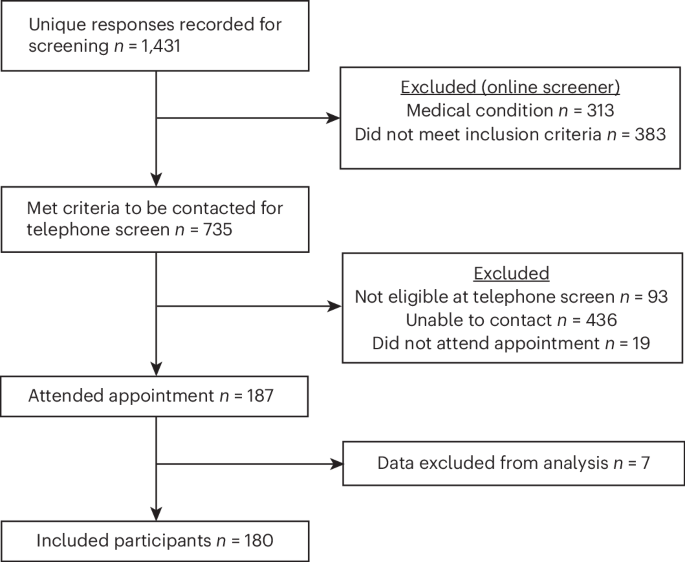
Three groups of participants were recruited: a control group with no self-harm history, a self-harm ideation group with a history of thoughts, but no enactment of self-harm ever, and a self-harm enaction group who had harmed themselves within the past 12 months. A flow chart outlining those potential participants who were excluded during screening and recruitment is displayed in Fig. 1. After exclusions due to non-response (n = 3), equipment problems (n = 3) or self-harm history (n = 1; seven excluded in total, n = 2 control, n = 2 self-harm ideation, n = 3 self-harm enaction), the final group numbers were: n = 62 control, n = 51 self-harm ideation and n = 67 self-harm enaction groups.
A full breakdown of the demographic characteristics of each group is outlined in Table 1. Sex was self-reported as ‘sex assigned at birth’, due in part to the biological nature of the study. Ethnicity was self-reported. It should be noted that recruitment was adversely affected by COVID-19, as it was halted as a result of the lockdown periods, and it was slower than we anticipated when the COVID-19 restrictions were eased and then lifted. Participant recruitment was delayed because of COVID-19, with recruitment beginning following the final COVID-19 lockdown in July 2021. Some participants (n = 19) were recruited when wearing face coverings in public places (including classrooms) was a legal requirement in Scotland (this restriction was lifted on 18 April 2022). Throughout recruitment, participants were informed that masks were optional, but it was not recorded whether they wore a face covering or not.
Participants were recruited using a range of approaches, including via online advertisements (for example, social media), advertisements placed in the community (for example, local colleges, psychology participant pool) and by contacting relevant organizations to share the study details (for example, Penumbra self-harm network, Bipolar Scotland, MQ Mental Health). Those who expressed an interest in the study completed a short online screening tool assessing their eligibility, which included questions about their self-harm history and health conditions that may make them ineligible for the cold pressor test and the physiological measures (for example, heart conditions, diabetes, epilepsy, Reynaud’s syndrome), and provided their contact details and a suitable contact time. Researchers then contacted potentially eligible participants by telephone to complete a brief screening, where their current self-harm and mental health history was assessed. Self-harm ideation was assessed with the question ‘Have you ever had thoughts of purposely hurting yourself whether or not you wanted to die?’ and self-harm enaction was assessed with ‘Have you ever hurt yourself purposely whether or not you wanted to die?’. Both were followed with ‘If so, when was the last time?’. Participants were eligible to take part if they had no history of self-harm ideation or enaction or any mental health diagnosis (controls), if they had self-harm ideation in the past 12 months but had never enacted (self-harm ideation group) and if they had enacted self-harm in the past 12 months (self-harm enaction). When a participant met the eligibility criteria, an appointment was made for the participant to visit the Mindstep Health Lab at the University of Glasgow. Those who took part received £30 as compensation for their time. Anyone ineligible to take part (through the online or phone screening) was thanked for their time and sent a support sheet listing the contact details of relevant organizations. Those who expressed recent self-harm ideation or behaviors were asked about their current desire to live, and a risk assessment and safety plan was conducted if they were deemed at risk.
Procedure
During the lab appointment (Supplementary Fig. 1 provides the study flow chart), participants were asked to read an information sheet and then signed a consent form to agree to take part in the study. They were told they could stop participation at any time without giving a reason. The experimental procedure included several phases: (1) a familiarization and baseline measurement phase, (2) a tonal habituation task phase, (3) an emotional images task phase and (4) a psychosocial stress task phase. Finally, participants were interviewed to assess their history of mental health disorders and self-harm (including with and without suicidal intent).
Electrodermal activity recording
Participants were familiarized with the EDA recording equipment. Two surface Ag/AgCl disposable electrodes were attached to the participants’ non-dominant hand (distal phalanges of the first and second fingers) to measure EDA throughout the experiment. The units used for measuring EDA electrical conductance are microsiemens (μS), with typical skin conductance levels in the range of 2–20 μS (ref. 19). For data acquisition, a BIOPAC MP160 module with an EDA100C-MRI Smart Amplifier was linked to a laptop using AcqKnowledge (version 5.0.5) software to process the EDA signal (Biopac Systems). The sampling rate was 25 Hz and the gain 2 μS V−1, the low-pass filter was set at 1 Hz and the high-pass filter at 0.05 Hz.
Baseline measurements
After familiarization with the EDA equipment, baseline recordings (3 min) of average SCL and the average amplitude of the NS-SCR were taken while participants viewed a neutral image (a black X on a white background). During this time, participants were instructed to rest their hand with the EDA electrodes in a supine position on the armrest and to move it as little as possible.
Tonal habituation task
This task uses impersonal tones to elicit the participants’ natural SCRs to auditory stimuli. Based on a similar procedure to that outlined in ref. 29, a series of 15 moderately loud sinus tones (80 dB, 1 kHz, 1-s duration) at varying interstimulus intervals (15, 20 and 25 s) were administered to the participants via headphones in a sequence that appeared to be random to the participant. An SCR to a tone must occur within 1–4 s after tone onset and have a minimum amplitude of 0.05 μS. Consistent with previous research15,29, the habituation rate was the number of the stimulus (that is, 1–15 tones) that produced the last SCR amplitude, and where no other SCR had been detected over three subsequent stimuli. Using AcqKnowledge (version 5.0.5) software, SCRs were identified and exported to Excel, and habituation rates were calculated (range 1–15).
Psychosocial stress task
The MAST47 was used to stimulate physiological stress responses. It includes five socially evaluated cold pressor trials where participants immerse their dominant hand in an ice-cold water bath for varying durations (60–90 s) over a 10-min time span. Between trials, participants are instructed to perform mental arithmetic as quickly and as accurately as possible, and receive negative feedback on their performance when mistakes are made. To heighten the social evaluation component, participants are falsely informed that they are being videotaped throughout for facial expression analyses. Throughout the stress task, consistent with previous research, SCLs are measured14,27, and data from three time points are extracted to determine differences in the pattern of electrodermal responding. Specifically, average SCLs are measured at three time periods (epochs lasting 90 s) at the start, middle and end of the task to establish how SCL changes over the course of the stress task for each group. The data were exported and epochs derived using PhysioData Toolbox (version 0.6.3)48 analyzers, which allow for the SCL signal to be low-pass-filtered (with shock removal) and smoothed by resampling the filtered signal with a 20-Hz time vector. The typical range for tonic SCL is between 2 μS and 20 μS (ref. 35). To be conservative we excluded individuals with an average SCL below 1 μS, with one participant excluded based on this criterion.
Emotional images
Participants were exposed to a series of 21 images selected from the International Affective Picture System (IAPS)49, before and after the psychosocial stress task (MAST). The images are designed to create an emotional response, and images from each of the valence (positive, neutral, negative) × arousal (high, low) categories were chosen. Images were presented in a randomized order to each participant at each time point. Like the tones task, any SCR that occurred within 1–4 s of image presentation was recorded as an EDA response to the image. An average SCR amplitude was calculated for positive, negative and neutral images at both time points, to assess whether the stress task had an impact upon responses to the images.
Diagnostic and self-harm history interview
Psychiatric history was assessed with a question directly asking whether they had ever received a mental health diagnosis. If yes, participants were given options for their diagnosis and could select as many as they felt applied: depression, ADHD, problems with irritability or anger, manic depression, mania or bipolar disorder, anxiety disorders (including panic attacks), problems with alcohol or drugs and any other emotional problems.
Self-harm history was assessed using the Self-Injurious Thoughts and Behaviours Interview (SITBI)50, a structured interview used to assess the presence, frequency and characteristics of self-injurious thoughts and behaviors, including suicidal ideation, suicidal attempts and non-suicidal self-injury. The SITBI is a widely used measure demonstrating good interrater reliability, test–retest reliability and concurrent validity with young people50.
Statistical analysis
All analysis was conducted using SPSS version 2951. No missing data were imputed. De-identified data and code for the current analysis has been made available on the Open Science Framework ( The literature suggests that SCL tonic data should be transformed to reduce skew and kurtosis in the data and adjust for individual differences19. A distribution is approximating normality if skewness or kurtosis (excess) values are between −1 and +1 (ref. 52). The literature recommends that logarithmic or square-root transformations are suitable to be applied to SCL data35. Although the data did not indicate extreme skew, some kurtosis was evident (Supplementary Table 1), and it was decided to transform the data as per the recommendations in the literature. Upon performing both logarithmic and square-root transformations, we found that the skew and kurtosis values better approximate normality with the square-root transformation (Supplementary Table 1). Therefore, SCL data were square-root-transformed, which had the additional benefit of removing some of the individual differences in SCL within the data, and guidance suggests that further adjustment for individual differences can be problematic and may not be necessary19. A similar procedure was applied to the SCR data in the emotional images task. Furthermore, a sensitivity analysis suggested that the results were similar, regardless of the transformation adopted (Supplementary Table 2).
Baseline measurement
We tested for initial baseline differences within the SCL tonic and NS-SCRs (that is, SCRs generated in the absence of stimuli) amplitude data to identify whether there were any individual level differences between the groups before any stimuli presentation, using one-way ANOVA; where applicable, Bonferroni post hoc corrections would also be applied. Sex (assigned at birth; male, female) differences in baseline SCL and NS-SCR amplitudes were also investigated using one-way ANOVA. Furthermore, we conducted a correlational analysis to establish whether baseline SCL and NS-SCR amplitude data were significantly associated and in which direction.
Auditory tones task
The outcome measure for the tones task was the habituation rate (range 1–15) for each participant, that is, the number of tones eliciting an SCR within 1–4 s, before three consecutive non-responses. GLM was used to test for differences between the self-harm groups in the tones task habituation rate, and analysis was adjusted for sex and age. GLM is an umbrella term that encompasses several models, expanding the general linear model so that the dependent variable is linearly related to the factors and covariates via a specified link function. This allows for the outcome variable (Y) to have an error distribution other than a normal distribution; it extends linear models to allow count variables, and it is useful when the data are clustered, for example, repeated observations of the same participants53. The output for models includes goodness-of-fit statistics (AIC and BIC), model effects (chi-squared) and parameter estimates, such as ORs. For the tone habituation task analysis, a Poisson log-linear model was selected, where the Poisson distribution is the number of occurrences of an event of interest, and the log link function transforms the count variable for analysis.
Psychosocial stress task
To test for self-harm group differences during the MAST, filtered SCL tonic data from three 90-s phases from the start, middle and end of the task were extracted using PhysioData Toolbox. The overall mean SCL during these phases of the MAST was calculated, and the self-harm groups were compared using multilevel linear GLM with the identity link function (as data have already been transformed). Within the models we included the covariates of age, sex and phase (three levels) of the task. Interaction for the self-harm groups with phase of the task was added to the GLM in a further model. The overall model effects for the variables and interactions are reported for each model in Table 4, and the ORs for each of the categorical variables in relation to tonic SCL are reported in Supplementary Table 3. Finally, we conducted a correlation analysis to establish the association between the SCR amplitudes generated during the tones task and the SCL during the phases of the stress task.
Emotional images task
An image must elicit an SCR within 1–4 s of image presentation, and the mean SCR amplitude in response to both positive (n = 7) and negative (n = 7) images was calculated. As with previous measurements, SCR amplitudes were square-root-transformed. GLM was used to test for differences between the self-harm groups in the mean SCR amplitude in response to negative and positive images, and this included a time variable for before and after the psychosocial stress task. A linear model was selected, because the SCR amplitude is a continuous variable. All analyses were adjusted for sex and age. However, there were high levels of non-responding, that is, participants not generating any SCRs, or only one or two SCRs, to the negative or positive images, and as we use an average SCR as the outcome, we were concerned about the robustness of these data. Specifically, post the stress task, n = 67 (37%) participants generated fewer than two SCRs to the 14 positive and negative images (a 14.2% response rate). Often, responses were not generated to either negative or positive images, so calculating an average score was compromised. It may be that the images were not sufficiently emotive, particularly given the repetition after the stress task. Consequently, we decided not to report these findings in the main body of the Article but to include these analyses in the Supplementary Information (Supplementary Table 4). For the analysis, in the interests of completeness, we included all participants who elicited at least one SCR to a positive or negative image (n = 131), and, on performing a sensitivity analysis, excluding those who did not respond to more than one image (n = 110), we found the results were the same.
Power calculation
Using a power calculation, based on previous research14, with an effect size of Cohen’s d = 0.47, with 0.80 power, alpha set at 0.05 and assuming a within participants correlation of 0.50, it was calculated that we would need 72 participants per group to identify an interaction between group and time. As noted, this was not achieved for each group, which may suggest that the interaction analysis may be underpowered. However, to identify main effects, a sample size of 52 participants was required, so there was likely sufficient power to identify main effects.
Reporting Summary
Further information on research design is available in the Nature Portfolio Reporting Summary linked to this article.
link