
Contamination and source-oriented health risk assessment of heavy metals in sediments: a case study of the Yixun River Basin, China
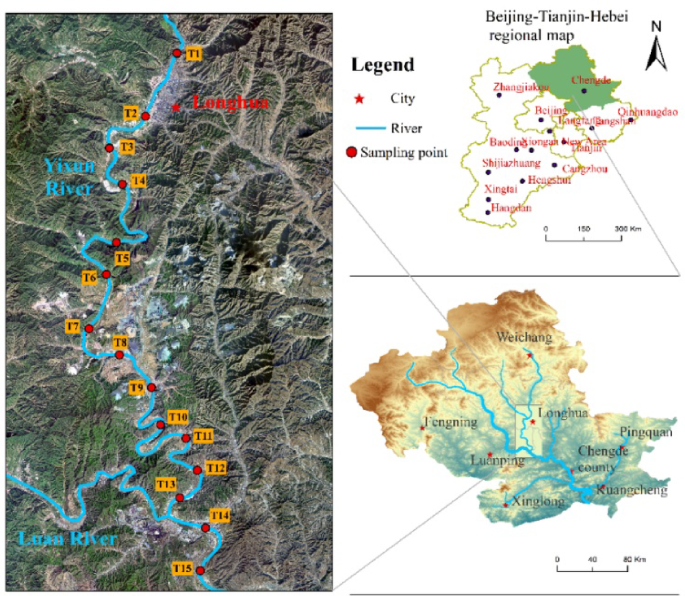
Environmental parameters of the Yixun River BASIN
Statistical results regarding the sediments and overlying water in the Yixun river basin are shown in Table S4. The pH value of the basin ranged between 7.13 and 7.56, indicating weakly alkaline conditions. The DO in the overlying water was considered enriched, as it ranged between 6.87 and 9.42 mg L–1, making it consistent with the characteristics of the basin reported in previous studies. The TDS ranged between 84.3 and 137.5 mg L–1, and the EC ranged between 157.9 and 273.7 μs cm–1. The organic matter content was low in the sediments from all of the sampling points, with a mean value of 0.94%. An analysis of the grain size distribution in the sediments revealed that coarse silt was the dominant component (43.70%), followed by clay (13.85%), fine silt (24.64%), and sand (17.81%).
Sediment heavy metal concentrations and spatial distributions
The pH values of the sediments in the study area ranged between 7.13 and 7.56, indicating weak alkalinity. The statistical results for HMs concentrations in the sediments are shown in Fig. 2. The total concentrations of Pb, Cu, Zn, Ni, Mn, and Ti ranged between 17.3–24.4, 9.8–113.3, 32.5–109.2, 34.8–66.5, 297.2–1160.4, and 2905.70–7932.60 mg kg−1, respectively. When ranked by average concentration, the HMs followed the order: Ti (5504.69 mg kg−1) > Mn (519.32 mg kg−1) > Zn (57.52 mg kg1) > Ni (50.07 mg kg−1) > Cu (43.31 mg kg−1) > Pb (21.77 mg kg−1). When these values were compared to the background ones for soils in the Hebei Province, the Ni concentrations exceeded the background values at all of the sampling sites, with an average 1.8-fold increase. The Ti concentrations averaged 1.4× the background value, while the Cu averaged 2× the background value. Although the remaining three HMs (Pb, Zn, Mn) did not exceed their respective background values overall, some sampling points did exhibit elevated concentrations. These results indicate a significant anthropogenic influence on the HMs concentrations in Yixun river basin sediments.

Spatial variation patterns of heavy metal concentrations in sediments from the Yixun river basin.
A coefficient of variation (CV) analysis of the HMs concentrations revealed distinct spatial patterns. Pb and Ni showed CVs of 8.06% and 18.71%, respectively—suggesting less spatial variability. The lower spatial variability of Pb, in particular, indicated that its major sources were likely weakly related to local point source HMs inputs from certain widespread non-point sources present across the study area (e.g., agricultural runoff). By contrast, the CVs for Cu, Zn, Mn, and Ti all exceeded 20%, indicating heterogeneous spatial distributions. As is shown in Fig. 2, Cu, Zn, Mn, and Ti all exhibited a trend of first increasing, and then decreasing, along the direction of the river’s flow, with notable peaks downstream of the T8 point. The highest concentrations were found in sampling sites T11, T12, and T13. Significant spatial variability and a notable local increase suggested that these patterns were likely attributable to inputs from pollution sources caused by frequent local human activities in the study area (e.g., mining).
Heavy metal speciation characteristics of the sediments
The speciation proportions of the HMs in the sediments across all of the sampling sites are presented in Fig. 3. Except for Cu and Pb, most of the HMs predominantly existed in the residual form and exhibited chemically stable behaviors—indicating they were primarily encapsulated within particulate matter and present as inert mineral phases. Notably, the residual forms of Ni and Ti exceeded 80%, likely owing to their strong binding affinity with residual lattice components in the sediments23, or predominantly natural origins. Although the proportions of Mn and Zn in their residual states were not as high as those of Ni and Ti, they nevertheless reached values of > 60%. This may be because Mn and Zn in river sediments come from the same source, but their relatively active metallic properties make them liable to react with organic matter or oxidizing substances in the sediments and thus transition away from their inert residual states32. One study on the HMs forms present in sediments from Baiyangdian Lake in Baoding, Hebei revealed that Pb was predominantly present in the Fe–Mn oxide-bound fraction; while Cu, Ni, and Zn were primarily in the residual fraction33. However, another investigation into the predominant forms of HMs in sediments from the Liujiang river found that most, except for Pb and Cd, existed mainly in the residual fraction—with Pb and Cd being dominant in the Fe–Mn oxide-bound fraction23. Comparisons between these studies indicated that the prevalent HMs forms in the sampled sediments varied significantly across the different research areas, being closely related to the factors that influenced the sediment sources in each basin.

Speciation of the heavy metals in sediments of Yixun river basin. Fr1, Fr2, Fr3, Fr4, and Fr5 represent the heavy metal forms determined using the Tessier five-step sequential extraction method, corresponding to the exchangeable, carbonate-bound, Fe–Mn oxide-bound, organic-bound, and residual forms, respectively.
The overall bioavailability of the sediment HMs is illustrated in Fig. 4. The bioavailability ranking was Pb > Cu > Zn > Mn > Ni > Ti, with Pb exhibiting the highest bioavailability (mean value of 90.68%), thus posing the most significant toxicological risks to aquatic organisms in the Yixun river basin. The Fe–Mn oxide-bound form was found to be the most dominant in terms of Pb bioavailability (Fig. 3). This is likely attributable to the strong adsorption capacity of reducible Fe–Mn hydroxides in sediments, which trap Pb ions in this form. Previous studies have confirmed that high concentrations of bioavailable Pb in sediments lead to its subsequent bioaccumulation in aquatic plants34. Cu showed a bioavailability of 83.78%, primarily of the carbonate-bound form, indicating that it was likely introduced by human activities. This form also has a high bioaccessibility to aquatic organisms. Pb and Cu, with their higher bioavailability levels, represent the primary drivers of toxicological impacts on aquatic systems. They should therefore be prioritized for remediation in water management strategies. Zn and Mn exhibited lower levels of bioavailability (32.16% and 31.56%, respectively), dominated by the Fe–Mn oxide-bound and organic-bound forms. Despite their relatively lower bioavailability levels, their total concentrations exceeded the background values for the region, thus suggesting that vigilance is warranted regarding their potential toxicity. The bioavailability levels of Ni and Ti were only 19.82% and 6.70%, respectively—both falling below 20% and thus indicating relatively minor threats to the aquatic ecosystems in the study area.

Proportion of bioavailable heavy metals in the analyzed sediments.
Identification of heavy metal pollution sources
The spatial variability of HMs concentrations in sediments of the Yixun river basin is significant, being closely associated with mining activities, agricultural practices, and domestic wastewater discharge along the river. Identifying HMs sources therefore provides critical data support for targeted pollution control35. In this study, APCS was applied to resolve the primary HMs sources in the sediments. After standardizing the monitoring data, a KMO-Bartlett sphericity test was also conducted. Its result was 0.641 (i.e., > 0.6), thus meeting the requirements for PCA. Bartlett’s sphericity test yielded a χ2 value of 85.038 (degrees of freedom, 15; significance level, 0.00). The test execution interval was < 0.05, confirming the normality of the data and validity of the PCA results (Table 1). Three PCs were extracted using the maximum variance method. Their eigenvalues were 3.71, 1.38, and 1.08 (i.e., all > 1). All three PCs were therefore determined to have significant contributions. The explained variances for the three PCs were 52.16%, 20.83%, and 17.47%, respectively, with a cumulative variance contribution rate of 90.46%, thus demonstrating their dominant influence on the HMs distribution in the sediments.
Based on the correlation analysis results among the HMs (Fig. 5), PC 1 accounted for 52.16% of the variance, with strong loadings for Ti (0.95), Cu (0.89), Zn (0.88), and Mn (0.74). Significant positive correlations were observed among these four HMs (correlation coefficients ranging between 0.58 and 0.99), indicating strong associations within their primary pollution sources. Based on the spatial variability of pollution concentrations, it can be inferred that these four HMs may share common sources from inputs associated with frequent human activities. Their likely common origin would explain the extremely strong correlations observed among Ti, Cu, Zn, and Mn. PC 2 explained 20.83% of the variance, being dominated by Ni (loading, 0.90). Ni exhibited weak correlations with the other HMs (correlation coefficients, ≈0), suggesting poor homology in pollution sources vs other metals. PC 3 contributed 17.47% of the variance, with moderate loadings for Pb (0.39) and Cu (0.40). A significant negative correlation (coefficient, 0.63) between Pb and Cu implied partially shared sources, but the correlation between the source locations was low.

Heavy metal correlations and principal component rotated factor loading analysis diagram.
Pollution source contribution rate analysis
To further determine the sources and contribution rates of the six HMs in the study area sediments, APCS-MLR was applied to the APCS-based pollution source results. This involved establishing functional relationships between HMs concentrations and pollution sources, predicting HMs concentrations using this functional relationship, and comparing predicted vs measured values through linear regression to obtain the relative contribution rate of each pollution source.
The coefficient of determination (R2) for linear regression between the predicted and measured HMs concentrations in the sediments ranged between 0.69 and 0.89 (Fig. 6). Specifically, Pb, Cu, Zn, Ni, and Ti all exhibited R2 values of > 0.80, indicating strong linear consistency, while Mn had an R2 of 0.69 (i.e., > 0.5). These results validate the robustness and reliability of the APCS-MLR model for analyzing the contribution rates of Yixun river basin sediment HMs. The analysis identified three dominant pollution sources (PC 1, PC 2, PC 3), as well as one unidentified source (PC 4), with relative contributions of 39.86%, 18.24%, 12.32%, and 29.58%, respectively. The proportional contributions of these sources to the six HMs are summarized in Fig. 6.

Contribution rates of heavy metal pollution sources.
The contribution rate of PC 1 was 39.86%, among which that of Ti was the most prominent (reaching 73.62%), thus indicating a close association between PC 1 and Ti pollution. The contribution rates of Cu, Zn, and Mn were 56.72%, 53.40%, and 45.70%, respectively, and those of all other assayed elements were relatively low (< 20%). Taken together with the earlier analysis of Ti pollution levels and speciation, this showed that Ti concentrations in most downstream areas exceeded background values, exhibiting a trend of first increasing and then decreasing along the river flow. Ti predominantly existed in the residual form, accounting for 93.30%—suggesting that sedimentary Ti in this area is strongly influenced by regional anthropogenic activities and enters water bodies primarily in inorganic forms, leading to sediment deposition. Sampling sites with elevated Ti concentrations (e.g., T6–T8 in Hongqiying Town, Luanping County) are located in a concentrated vanadium-titanium magnetite mining and mineral processing area, which is consistent with the observed Ti variation patterns and its inert elemental form. Prior studies on mining and mineral processing waste rocks in this region have revealed that Ti, Cu, Zn, and Mn concentrations in the waste exceed background soil values, with all HMs exhibiting high residual forms. Under intense mining activities, the surrounding soils showed moderate levels of Ti, Zn, and Mn. As was further detailed in Section “Determination of heavy metal concentrations and speciation”, the speciation of Ti, Zn, and Mn in the sediments also demonstrated a predominance of inert residual forms, while Section “Absolute principal component score-multiple linear regression model” indicated significant positive correlations among these four HMs—thus highlighting their strong association relative to the pollution sources. Therefore, PC 1 was identified as originating from mining sources.
The contribution rate of PC 2 was 18.24%, with a relatively high contribution to Ni at 67.30%, indicating that PC 2 primarily reflects Ni-based pollution sources. Studies have shown that the main environmental sources of Ni are electroplating wastewater discharge and industrial metal production. Because of its excellent plasticity, acid corrosion resistance, and high-temperature tolerance, Ni is widely used in electroplating, battery manufacturing, and machinery equipment industries36. Therefore, PC 2 was identified as an industrial source.
The contribution rate of PC 3 was 12.32%, with significant contributions to Pb and Cu that accounted for 34.5% and 24.3%, respectively. The results of sediment HMs speciation analysis further indicated that Pb and Cu in the sediments exhibited high bioavailability, with bioavailable forms of 90.68% and 83.78%. This suggested that the Pb and Cu in PC 3 were predominantly associated with non-residual, reactive forms. The excessive application of organic fertilizers and phosphate fertilizers during agricultural activities represents a primary source of Pb accumulation37. Cu is frequently added to livestock feed as a trace element in the form of copper sulfate38, eventually entering aquatic environments through livestock manure. Both Pb and Cu from fertilizers and livestock wastewater retain their bioavailable forms in sediments. Thus, PC 3 was classified as an agricultural source.
The contribution rate of the unidentified pollution sources was 29.58%, involving Pb, Zn, and Mn. No significant correlations were observed among these three HMs, indicating that the unidentified pollution sources encompassed multiple factors. Human activities such as domestic wastewater discharge, for instance, can enhance the environmental diffusion of Mn39, while transportation-related activities (e.g., vehicle tire abrasion, brake pad wear, and exhaust emissions) represent major sources of Zn and Pb pollution40. The other unidentified pollution sources may have included urban runoff, atmospheric deposition, and others. Therefore, the unidentified pollution sources included other contamination factors beyond mining activity sources, industrial sources, and agricultural sources—though these represented only a minor component of the total HMs inputs.
These findings demonstrate that the primary pollution sources in the study area are most likely mining activity, industrial, agricultural, and unidentified sources. The downstream T8 sampling site exhibited more severe impacts from mining activities, where inert elemental residual forms of pollutants accumulated in the sediments to make the Ti, Cu, Zn, and Mn concentrations in the region exceed the background soil values. However, the bioavailability levels of these HMs remained low. The Ni in the sediments most likely originated primarily from industrial sources, while the Pb and Cu were predominantly linked to agricultural sources such as organic manure and aquaculture wastewater.
Health risk assessment of bioavailable heavy metals
Based on the bioavailable HMs concentration data detected in the sediments, a health risk assessment model was applied to evaluate the carcinogenic and non-carcinogenic risks of bioavailable HMs in the sediments (see Fig. 7). The total non-carcinogenic hazard indexes (HI) for adults and children were calculated to be 0.37 and 1.88, respectively. Since the HI and individual hazard quotient (HQ) values for adults were all < 1, the non-carcinogenic health risks posed by HMs in the Yixun river basin sediments were deemed insignificant for adults. However, the HI for children was > 1, indicating significant adverse non-carcinogenic health impacts. Among the two exposure pathways for children, the HQ values were ranked as follows: dermal contact exposure (1.53) > oral ingestion exposure (0.35), suggesting that dermal contact with sediments posed a higher non-carcinogenic risk. For the individual metals, the HQ values that contributed to the non-carcinogenic risks in children, from lowest to highest, were: Pb (1.57) > Cu (0.11) > Ni (0.08) > Mn (0.07) > Zn (0.01)—with Pb being the dominant contributor.

Heavy metal health risk indexes and source contributions.
The Total Carcinogenic Risk Index values for adults and children were calculated to be 1.24 × 10⁻⁴ and 4.34 × 10⁻⁴, respectively—both falling within the 10–6–10–4. This indicated that the Yixun river basin sediment HMs may pose carcinogenic health risks to both populations, with children being significantly more affected than adults. For both exposure pathways (oral ingestion and dermal contact), the carcinogenic risk values for adults and children followed the same ranking: oral ingestion > dermal contact—suggesting that oral ingestion represented the primary pathway driving the carcinogenic risks for both groups. Among the individual HMs, the carcinogenic risks for adults and children were consistently ranked as Ni > Pb. Notably, the carcinogenic risk for Ni exceeded 10–5, making it the dominant contributor to carcinogenic risks in the region. Conversely, Pb’s carcinogenic risk was < 10–6, thus remaining within the acceptable human health limits. Combining these findings with the analysis in Section “Identification of heavy metal pollution sources”, the elevated Ni concentrations found in Yixun river sediments—attributable to pollution from electroplating, battery production, and metal manufacturing industries—are likely responsible for significant carcinogenic risks via oral ingestion pathways, thus posing significant health threats to the local populations.
Bioavailable forms of HMs pose significant carcinogenic and non-carcinogenic risks to children, primarily attributed to Pb from agricultural sources and Ni from industrial ones. Therefore, reducing the amount of activities that put children into contact with water is crucial in the Yixun river basin is crucial. Controlling the input of Pb from agricultural activities and strictly limiting the discharge of industrial Ni-containing wastewater should also be considered.
link