
Characteristics, source apportionment, and health risk assessment of heavy metal pollution in soil of jiangmen, China
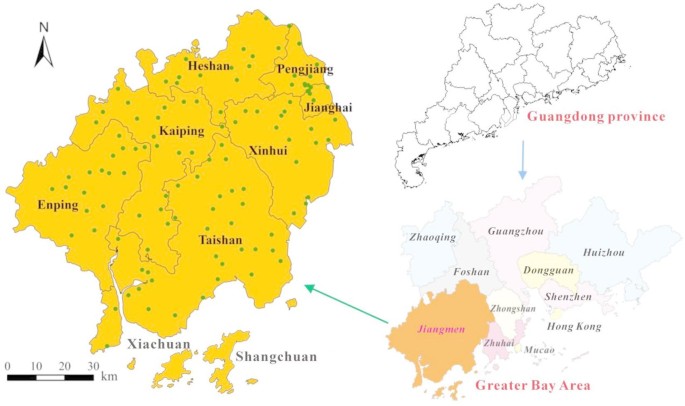
Statistical analysis of heavy metals concentrations
The statistical analysis of heavy metals concentrations in Jiangmen’s soil are presented in Fig. 2 and Table S2. The mean values of As, Cd, Cr, Cu, Hg, Ni, Pb and Zn were 11.00, 0.21, 61.09, 28.22, 0.11, 24.72, 49.03 and 92.08 mg/kg respectively. Among them, the average concentrations of As, Cr and Zn are close to their respective background values, while the average concentrations of Cd, Cu, Hg, Ni and Pb exceed the background values (Soil background values refer to the National Standards Information Public Service Platform of China, URL: Compared with the screening values specified in Soil Environmental Quality Risk Control Standard for Soil Contamination of Development Land (GB 36600 − 2018), the arsenic concentration in 6 samples exceeds the screening value for Class I land (there are no corresponding standards for Zn and total Cr). This indicates that the soil quality of Jiangmen’s construction land is generally good, but individual point source pollution requires further attention.
In the aforementioned emissions, the content of Cd ranges from 0.02 to 1.55 mg/kg, exceeding the background value by 183.8%, which may be related to industrial emissions and domestic pollution sources³¹. As an industrial city in the GBA, Jiangmen has a dense transportation network and is home to several large electronic industrial parks and factories. During the years-long production and transportation of products in these parks and factories, heavy metal pollutants are emitted into the air and soil. After long-term accumulation, adsorption, and deposition, the Cd content in soil samples exceeds the local background value31. The contents of Cu, Hg, Ni, and Pb exceed the background value by 19.6% ~ 93%, which is closely related to human activities such as industrial emissions and traffic emissions in Jiangmen25,32.
A coefficient of variation (CV) > 20% can reflect the impact of human activities33,34. In this study, except for Hg, the coefficients of variation of all heavy metals are above 20%, indicating that human activities have a significant impact on their accumulation. In addition, there are obvious differences in heavy metal concentrations among different districts and counties in Jiangmen. Among them, Cd and Pb are the most accumulated metals in the soil of the city, with 78% and 80.5% of the samples exceeding their background values, respectively (Table S2). Studies have shown that Cd is released into the atmosphere, water, and soil during metal smelting, waste incineration, and fossil fuel combustion35; while Pb may also come from asphaltenes and mineral fillers in asphalt36. The highest average concentrations of Cd, Cr, Cu, and Ni are found in Jianghai District, while the highest average concentrations of As, Hg, and Zn are found in Pengjiang District. Khan et al.35 pointed out that Cd, Cu, Hg, and Zn mainly come from industrial activities. Therefore, due to factors such as transportation geography and dense industrial park areas, long-term industrial activities and traffic emissions are important sources of heavy metal accumulation in Jiangmen.

Box-plots of the concentrations for heavy metals in soil of Jiangmen City (mg/kg). Green line represents the background values of Guangdong province; Black line represents the mean value of each heavy metal.
The Spatial distribution characteristics of heavy metals
The spatial distribution characteristics of soil serve as an effective means to assess potential sources of heavy metal enrichment and identify areas with high-concentration heavy metal pollution23. Figure 3 summarizes the spatial distribution of various heavy metals in the study area.
As shown in Fig. 3, relatively high concentrations of As are mainly distributed in Jianghai District, Pengjiang District, Heshan and Taishan, while concentrations in other areas of Jiangmen are relatively low. As the urban center of Jiangmen, Jianghai and Pengjiang Districts have dense populations, busy traffic, and a concentration of factories, resulting in high emissions of air pollutants. Heshan, an industrial county-level city in northern Jiangmen, is home to numerous industrial parks and the Xijiang Canal; intensive human activities may be a key factor contributing to the high As concentrations in this area. Taishan, a county-level city in south-central Jiangmen, has fewer factories and less busy traffic. However, it is rich in geothermal resources, and hydrothermal fluids in hot springs can transport trace elements to the surface, suggesting that high-background rock compositions may be a natural source of elevated As concentrations. Additionally, Sanhe Town, renowned for its ceramic mining industry, is another significant anthropogenic source of As, as As is a common impurity in borate minerals used in ceramic processing37. Thus, the spatial distribution of As in Jiangmen reflects the diversity of its sources.
Cd and Cr exhibit similar spatial distribution patterns, with high concentrations primarily concentrated in Pengjiang and Jianghai Districts. This area features dense road networks, transportation hubs including large bus stations, railway stations, and ferry terminals, as well as a dense distribution of industrial parks. The spatial distribution shows a clear boundary between high and low concentration areas. The rapid urbanization of these urban areas has led to increased energy consumption and pollutant emissions38 with the continuous accumulation of Cd and Cr in soil mainly stemming from transportation and industrial production activities.
Cu, Hg, Ni and Zn also show similar distribution characteristics of high concentrations, primarily located in Pengjiang District, Jianghai District, Heshan, and northern Xinhui District. Benefiting from China’s reform and opening-up policy, Jiangmen has witnessed rapid development in water transportation and industrial park construction. Particularly in areas near the Xijiang River and the estuary (Xinhui District is located near the estuary), extensive industrial production and freight transportation activities have led to the continuous accumulation of heavy metals. Zhao et al.39 noted that the distribution of Cu, Zn, and Hg in the Pearl River Delta’s soil is closely related to the intensity of industrial activities. Furthermore, these high-concentration areas have dense populations, resulting in concentrated emissions from domestic coal combustion; studies have shown that fossil fuel combustion accounts for 45% of anthropogenic Hg emissions40.

Spatial distribution of heavy metals in soils of Jiangmen City (This map was drawn with the assistance of ArcGIS Pro 3.3 version. Website: https://www.esri.com).
The spatial distribution of Pb differs significantly from that of other heavy metals. Its high-concentration areas are mainly distributed in Pengjiang District, Jianghai District, Xinhui District, Heshan, northern Kaiping and northern Enping, showing an overall semi-circular distribution. Adjacent to major highways, traffic activities are the primary source of Pb in surface soil, suggesting that automobile exhaust is one of the main sources of Pb pollution. Additionally, this area is home to electronic industrial parks and chemical plants; during production and transportation processes, industries such as electronic device manufacturing and metal processing in these parks release Pb into the environment, which then accumulates continuously in the soil.
Source apportionment of heavy metals pollution
Identifying the sources and influencing factors of pollutants is crucial for the prevention and control of soil pollution41. In this study, to identify the primary sources of soil pollution in Jiangmen, we employed a combined approach of Pearson correlation analysis and the PMF model to conduct qualitative and quantitative source apportionment of soil pollutants. It has been confirmed through normality and homoscedasticity tests that all data used for Pearson correlation analysis in this study meet the aforementioned assumptions, indicating that this analytical method has good applicability. Drawing on previous research data from the study area30 the PMF analysis was performed with 3 ~ 5 factors and 20 iterations. The optimal solution was determined by selecting the minimum and most stable Q value, ultimately identifying three dominant pollution sources with contribution rates of 31%, 50%, and 19% respectively (Fig. 4, Fig. S2).
Factor 1 accounted for 31% of the total variance, with Pb, Zn, and Cd contributing 79.0%, 71.7%, and 82.9%, respectively (Fig. 4). The correlations between these elements were highly significant with p < 0.01. As reported in previous studies, Pb and Cd are important markers of traffic related sources39,42. The spatial distribution of these elements revealed that Pb concentrations were significantly different from those of Zn and Cd (Fig. 3). High concentrations of Zn and Cd were concentrated in the old city centers of Jianghai and Pengjiang Districts, while high concentrations of Pb are mainly distributed in Xinhui District. Tire dust, automobile fuel combustion, and train braking emissions are likely the main contributors to non-point source pollution of Cd in urban areas39. Zhang et al. demonstrated that in coastal cities, shipping emissions and exhaust are significant factors influencing the spatial distribution of Pb43. Xinhui District, with its rivers connecting to the sea, has developed a robust shipping industry, featuring three 10,000-ton berths and nine 5,000-ton berths. Therefore, Factor 1 was identified as a combination of land traffic and shipping emissions.

Source apportionment of heavy metals in soils of Jiangmen City. (a) The percentage of different pollution sources; (b) Species contribution of 3 pollution sources for heavy metals; (c) Combined illustration of 3sources and partial correlation analysis among heavy metals.
As shown in Fig. 4, the dominant element in Factor 2 was Hg. The CV for Hg was relatively high in Xinhui District and Taishan County, exceeding 100% (Table S2). This suggests that anthropogenic sources significantly influenced Hg levels in these areas. Industrial activities such as fossil fuel combustion, metal smelting, and cement production are major sources of Hg accumulation in soil2. Fossil fuel combustion alone accounts for 45% of anthropogenic Hg emissions44. According to the Jiangmen Statistical Yearbook and field investigations, Xinhui District and Taishan County host numerous industrial enterprises, with coal consumption reaching 1.97 million tons and 11.22 million tons, respectively. This coal consumption is 1–3 orders of magnitude higher than in other counties and districts in Jiangmen. In 2021, Xinhui District recorded the highest total industrial output value, highlighting the prevalence and scale of industrial activities in these areas. Hg emissions from the printing and dyeing industry in Jiangmen are a significant source of soil Hg accumulation. Combining the spatial distribution of Hg, Factor 2 was attributed to industrial emission deposition.
Factor 3 was characterized by contributions from Cr, Cu, Ni, and As, accounting for 71.7%, 52.7%, 64.0%, and 62.9%, respectively. Generally, Cr and Ni primarily originate from soil parent materials and natural processes, with minimal influence from human activities. In this study, the ratios of Cr and Ni exceeding background values were the lowest among all sampling points. The average concentration of Cr was close to the background value, while that of Ni was lower, indicating limited anthropogenic impact. Hu et al. also demonstrated that Ni and Cr in the topsoil of the Pearl River Delta are mainly derived from parent materials45. However, the influence of human activities cannot be entirely disregarded.
As has complex sources, being released during the mining, transportation, and processing of arsenic ores, as well as through the use of pesticides and fertilizers. For example, herbicides often contain inorganic arsenic compounds such as lead arsenate, sodium arsenate, and calcium arsenate46. Additionally, the application of phosphate fertilizers is a major pathway for arsenic entering the soil47. Similarly, Cu and its compounds are added to pesticides, fungicides, and livestock feed, eventually entering the soil through manure. In China, approximately 5,000 tons of Cu are used annually in agricultural products48. Therefore, Factor 3 was identified as a combination of parent materials and agricultural activities.
In contrast, Liang et al. attributed As and Cu to industrial activities, which differs slightly from our findings. This discrepancy may arise from differences in urban functional structures. Liang’s study area, located in northern Guangdong Province, is dominated by industrial and mining activities, which likely contribute more heavy metals2.
Risk assessment
Ecological risk assessment
The ecological risk of heavy metals in Jiangmen’s soils was evaluated using PI and the potential RI23. In this study, the PI value for each heavy metals was calculated as the ratio of the measured concentration to the tolerable or allowable levels in soil for plant growth49. A PI value greater than 1 was considered indicative of mild pollution. As shown in Table 1, nearly all districts and counties, except for Enping City, exhibited moderate soil pollution. The PI values for heavy metals in Jianghai, Pengjiang, and Xinhui Districts were relatively high. Figure 5 further illustrates that the severely polluted areas were primarily concentrated in Pengjiang, Jianghai, and Xinhui Districts. This is closely linked to the long-term accumulation of traffic and industrial emissions in the old urban areas of Pengjiang and Jianghai Districts. Additionally, the industrial development in Xinhui District, a key area for industrial output in Jiangmen, inevitably contributes to potential environmental hazards.

Spatial distribution of PI and potential RI of Jiangmen City (This map was drawn with the assistance of ArcGIS Pro 3.3 version. Website: https://www.esri.com).
In terms of potential ecological risk, the areas with the highest risk were mainly located in Jianghai and Pengjiang Districts (Fig. 5), where the RI values exceeded 300, indicating a serious threat to the ecosystem. Among the heavy metals, Cd, Cr, and Cu were the primary contributors to ecological risk in Jianghai District, while As, Hg, and Zn were the key drivers in Pengjiang District. These patterns are closely associated with the accumulation of pollutants resulting from the early stages of industrialization and urbanization in the old urban areas of Pengjiang and Jianghai Districts, as previously discussed.
In contrast, the RI values for Kaiping, Enping, and Heshan were below 150, classifying these areas as low-risk. This suggests that ecological damage caused by heavy metals in these regions is not a prominent issue, and future environmental management and pollution prevention planning can prioritize other concerns50.
Health risk assessment
Based on the identified pollution sources, the health risk of heavy metals in soil of Jiangmen city was calculated for different exposure pathways and pollution sources for adults and children. The results are presented in Table 2; Fig. 6. As shown in Table 2, the average hazard index (HI) values for non-cancer risk in the study area were 1.76E-02 and 1.48E-01 for children and adults, respectively. Since HI < 1, the non-carcinogenic risks associated with heavy metals in Jiangmen’s soil are considered acceptable for both children and adults51. The average total carcinogenic risk (TCR) values were 5.45E-08 for children and 1.23E-07 for adults. Generally, a TCR value below 10−6 is considered acceptable or tolerable, while a TCR value above 10−4 indicates potential risks requiring attention.
Based on a comparison with the health risk assessment results of other cities in the GBA (Table 3), it can be seen that the HI for adults in Jiangmen is lower than that in cities such as Zhuhai, Dongguan, and Zhongshan, but higher than that in Guangzhou, Shenzhen, Huizhou, Foshan, and Zhaoqing. For children, Jiangmen’s HI is lower than that in Zhuhai, Guangzhou, Shenzhen, Dongguan, Zhongshan, and Foshan, and only higher than that in Huizhou and Zhaoqing. In terms of TCR, the values for both adults and children in Jiangmen are lower than those in cities including Zhuhai, Guangzhou, Shenzhen, Dongguan, Zhongshan, and Foshan. Overall, Jiangmen’s HI and TCR are at a medium level within the GBA, while Huizhou and Zhaoqing have relatively the best health risk status.
The results demonstrated that exposure to pollution through ingestion pathway is particularly significant for children which cannot be overlooked. It is crucial for parent to provide proper guidance to prevent children from ingesting soil due to unhealthy habits.
Based on source-oriented risk analysis, a Sankey diagram illustrating the relationships between heavy metals, pollution sources, and health risks was constructed (Fig. 6). As shown in Fig. 6, the contribution of different pollution sources to the TCR follows a consistent pattern across various populations, with the order of contribution being Source 2 > Source 1 > Source 3. Specifically, in the child population, the CR value from industrial emissions (Source 2), the largest pollution source, is 2.73E-08, which is approximately 0.027 times the acceptable threshold (1E-06). In the adult population, the CR value from this source is 6.15E-08, about 0.062 times the threshold, and the carcinogenic risks from all sources do not exceed the unacceptable risk threshold (1E-06). In terms of element contribution characteristics, Pb, Cd, and Zn account for the highest proportion in Factor 1; Hg is the dominant element in Factor 2; and Cr, As, Cu and Ni are the main contributors to Factor 3. Similar to the pattern of carcinogenic risks, industrial emissions are also the primary source of non-carcinogenic risks, and the changing trends of HI caused by different sources are consistent in both children and adults. Specifically, the average HI values from various sources in the child population are as follows: industrial emissions 8.78E-03, traffic and shipping emissions 5.44E-03, and mixed sources 3.34E-03. In the adult population, the average HI values are: industrial emissions 7.40E-02, traffic and shipping emissions 4.59E-02, and mixed sources 2.81E-02. It is worth noting that Hg has the highest contribution rate to risks among industrial emission sources. The results of non-carcinogenic risk assessment show that the HI values for both children and adults are below the safety threshold (HI < 1).
A comparison of the composition of pollution sources in other cities of the GBA shows that: pollution in Zhuhai mainly comes from industrial emissions, agricultural chemicals and natural sources52; pollution sources in Guangzhou are dominated by traffic emissions (47.6%), followed by industrial emissions (29.4%) and agricultural mixed sources (23%)53; pollution in Shenzhen is mainly from industrial emissions, domestic waste and traffic emissions54; pollution in Dongguan is concentrated in industrial emissions and mixed sources55; pollution in Zhongshan takes traffic emissions as the primary source56; pollution in Huizhou mainly comes from agricultural emissions and traffic emissions57; pollution in Foshan includes industrial emissions, traffic emissions and urban construction pollution58; pollution in Zhaoqing is dominated by agricultural and traffic mixed sources (45.8%), followed by industrial emissions (29.5%) and other sources (24.7%)59. Based on the above comprehensive comparative analysis, it can be seen that the sources of heavy metal pollution in various cities of the GBA show little overall difference, with the core being mixed sources composed of industrial emissions, traffic emissions and agricultural emissions.
Overall, industrial emissions have been identified as the priority pollution source for control, a conclusion that is highly consistent with Jiangmen’s prominent industrial development characteristics. In 2024, the city’s industrial output value accounted for 39.3% of its gross domestic product (GDP) and has shown a year-on-year growth trend. It is thus evident that while promoting economic growth, the municipal government urgently needs to simultaneously address environmental issues caused by industrial emissions. Only in this way can a solid foundation be laid for the city’s sustainable development.

Sankey diagram of the relationship among heavy metals, sources, and health risks. (The width is proprotional to the contribution level).
link